Showing posts with label wiki. Show all posts

Wednesday, March 25, 2009

Do wikis work for any topic? How about math?

Sabah Karam from Morgan State University in Baltimore, Maryland, recently wrote to me asking:

“I have been doing research on how wikis can be used to teach students
how to do mathematical proofs…. I would like to know if you have any thoughts on if you think we this is a realistic effort and, so, how we can achieve this goal.”

Great question! I personally believe that a wiki can succeed on any topic. A wiki is merely a tool for collaborative document authoring by a group. The more important factor that determines the success of a project is the vested interest of the team members (or community) working on it.

So to ensure success in a project like collaborative authoring of mathematical proofs, efforts should be placed into:

  • defining the output (deliverable) and the timelines of the project

  • defining your community (i.e. team members) that will work on the project

  • selecting the right tools to enable the community to produce the desired product in the timeline specified (a wiki is one example of a good document collaboration tool)

  • providing a convincing argument to members of the community to educate them about the value of the tool(s) that were selected for the project

  • providing training on these tool(s) for those members of the community who need it

  • overseeing the completion of the deliverables folloowing the agreed upon timeline

On the subject of wikis that concern themselves with mathematical proofs, there are two that I know of Proofwiki and PlanetMath. Does anyone else know of any? if so, leave a comment below.

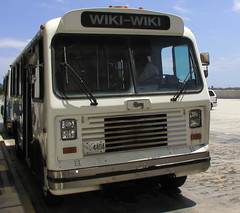
Image credit.

Thursday, October 23, 2008

cck08: Wesch Strikes Again!

I can't get enough of this. The University of Manitoba recently posted the video of Micheal Wesch's June 17, 2008, talk entitled "A Portal to Media Literacy" where you can get a glimpse into how Micheal organized a couple of his classes at Kansas State University. He strives to create platforms of participation for students that leverage the emerging media environment. He shows how to let students participate in their learning in an open way to harness the 'upload world' they are familiar with. Some great illustrations of practices in wiki and RSS aggregator usage are found in this video... just in time for this week's CCk08 topic of Instructional Design and Connectivism! Food for thought!

In fact, I'm revamping one of my courses for Winter 2009 (Biol2: Intro to Molecular Biology) and I am going to use a wetpaint wiki as a type of portal for my students to bring together course information. I'll be sure to write about it on this blog once I get the wiki slightly more crytalized.

Note: image credit located here.

Monday, June 02, 2008

Wikis in the Classroom - iGlobe

I attended the Eastern Ontario Symposium on Educational Technology (EOSET) hosted by the University of Ottawa last Thursday (May 29th). The format this year was different than in the past. It consisted of a series of short 10 minute presentations. One talk that I found interesting was by Mark Salter in the School of Political Studies at the University of Ottawa. He described his large introductory class in "Politics of Globalization" which he branded as ‘iGlobe’ to attract student attention on the materials and to convey that this course was different than other politics courses. It sure was. Mark mixed aspects of problem-based learning (PBL), wikis and pod-casting into the materials of his course. His course has two assignments (in which students had choice as to what deliverables they had to submit) and two exams. Mark reported that often in undergraduate politics courses, professors give feedback to students on their papers and students do not get the opportunity to integrate that feedback into future assignments. He felt that by using the wiki in the course that students could take advantage of professor (and peer) feedback to improve their work by incorporating feedback. I have written on the topic of using wikis as class assignments before, so it is clear to the readers of this blog that I am very pro-wikis. Mark mentioned a good point that I took away from this presentation: he felt that students need a significant amount of training on how to use a wiki in the context of education. In his experience, the concept of a wiki was new to some of his students and so basic training on how to operate it was necessary.


In addition, he felt it was important to emphasize to the students that the goal of using a wiki in this course is not to create as many pages as you can, but rather to create a few pages and edit them extensively and repeatedly. The cycle of ‘research-write-feedback-edit-repeat’ was the preferred activity here. Not simply a linear ‘write as much as you can’ scenario. It is this feedback integrating cycle that is the key in an educational context! The entire course is still a work in progress and you can check out the iGlobe wiki here.

If you use wikis in your undergraduate courses, let us know how they are working in your context by leaving a comment below.

Wednesday, March 26, 2008

Wikis as Assignments

I attended a very useful online presentation last week by Mike Orey of the University of Georgia (via the Wimba Distinguished Lecture Series). In one of his graduate courses in education, as an assessment activity, he asks students to contribute to a wiki-book that he and his colleagues have developed: Emerging perspectives on learning, teaching and technology. The reason I am making this posting is two-fold.
  1. The concept of asking students to contribute to a wiki that will remain for future users is very interesting to me. Clearly an assignment of this nature fits into the highest levels of Bloom's Taxonomy and could even serve as a capstone assignment in some types of courses. In Mike's example, he created a privately owned wiki for this purpose; however, Wikipedia could be used as well.


  2. Mike's eBook is excellent from a practitioner’s point of view! Have a look it. It has some interesting sections on topics such as Motivation, Adult Learning, Problem-based Instruction and Learning Communities as an Instructional Model. Chock full of case studies and well referenced with supporting literature. If applicable, Mike encourages you to adopt all or part of this eBook as a textbook in your course. He's so nice (*smile*).

Kudos to Mike & friends on more than one level!

Tuesday, March 25, 2008

Project Management using Google Sites

My office has been playing around with the Google Sites wiki for the last few weeks (I’ve written about Google Sites before.) We’ve been using it to collaboratively author mini-reports as well as staff meeting agendas.

I would like to try to use a wiki site to track an online course development project. It would be a place where the project team could define goals, publish milestones, post files and monitor progress on project activities. I think Google Sites would be perfect for this and it is an easy to use and free online application. I am definately going to use it when I start my next project.

Today I came across someone else who has built a nice Google Sites template for project management activity. Check out the link and let me know what you think by leaving a comment below.

Thursday, February 28, 2008

Free Wiki Hosting by Google

Google finally gets into the Wiki game by re-launching the product they acquired last year (JotSpot) under a a new name: Google Sites. See this description of the product via TechCrunch blog. I'll be trying it!

Thursday, March 08, 2007

Wiki uses at Universities

Wikis, a popular Web 2.0 technology, are being implemented increasingly in higher education settings. Some universities have deployed a university-wide wiki while others have deployed department-specific wikis.

(Some of these wikis have been taken down - they existed at the time I wrote this post in March 2007). Some examples of universities in the USA that have deployed a wiki are: University of Southern California, Case Western Reserve University, Ohio State University, Stanford University, Brown University, Hampton University, University of Virginia , University of Florida, Yale University and University of Chicago . Some UK examples are: University of Bath and University of Wales. Wiki installations have been noted at these Canadian universities: University of Calgary, McGill University, Brock University, York University, Queen’s University, University of Toronto, University of Ottawa, Carleton University and McMaster University.

In general, these institutions are using wikis for these main purposes:
  • Manage communication for collaborative staff projects (i.e. Project Management)

  • Facilitate professional collaboration, and document authoring, online between staff and other professional colleagues inside and outside of the institution

  • Allow university-associated athletic clubs and student groups to have a user-editable web presence

  • Propagate community news

  • Allow academic classes to build a group wiki on a topic/idea

  • Allow groups of students to build a wiki for the creation of a shared academic deliverable (i.e. research projects, presentations, reports)

  • Manage and maintain documents online that need frequent updating such as SOPs, policy, procedure and orientation manuals

  • Allow front line workers to easily build online FAQs

  • Joint authoring and archiving of committee minutes

  • Collaborative website space for an academic/professional conference or meeting

My institution, RMC, could benefit from a wiki installation, as it would bring all the many above benefits to diverse facets of the RMC community: Academic Teaching, Research, Social and Administrative.

From a Course Design and Development (CDD) perspective at the Division of Continuing Studies, there could be many useful benefits to having an RMC-hosted wiki. Here are two examples:

Example #1: Pedagogical point of view

Some DCS courses offer students the option of using non-RMC hosted free wiki services to facilitate group collaboration in projects at a distance. At this time, no known hosted free wiki services can cross the PWGSC DWAN firewall. If RMC were to host a wiki, wiki software could be chosen that would be firewall-friendly, such as MediaWiki. The addition of a student-to-student, and/or student-to-instructor, collaborative tool such as a wiki would complement very well the WebCT and DNDLearn LMS functionalities currently at RMC, especially if it is compatible with the PWGSC DWAN firewall. Furthermore, wiki software could be deployed in both official languages.

Example #2: Staff productivity point of view

The Course Design and Development process at CDD operates under a project management framework and often has Course Development Teams with members that are geographically dispersed. A wiki would allow a team member-editable web space where project management and status information could be communicated and shared. This same wiki could also serve as the location for the joint creation of text-based documents by the Course Development Team. The built-in wiki functions of document change history (that identifies precisely the author of the change), and document recovery at any point in the editing of a page, would be powerful tools for accurate document version control in this group collaboration.

Comments?

Wednesday, January 24, 2007

Support Materials for using Wikis at a Distance

I am currently designing and developing a masters level course on Entrepreneurship that will be delivered at a distance in a web-enabled format. The professor and I have decided that the major assignment in the course will be to create a business plan. Students will be put together in pairs and asked to produce a 1st draft business plan. Selected members of the class will provide feedback to each draft business plan and then the pairs of students will finalize their business plan for submission to the professor. In order to facilitate collaborative authorship of the business plan, despite students being geographically separated from each other, we chose to offer students the option of using a Wiki. I’ve written about Wikis before so this post won’t be re-iterating what I’ve already discussed. Instead this post is more of a show and tell. In this course, we’re not obliging the groups to use a Wiki; however, we’re providing details on how to use one in case they want to try it. I have created two support documents for students:

1) A Word handout, which describes what a Wiki is, suggest one free Wiki service (i.e. www.WikiSpaces.com), and briefly gives the steps on how they can get started.
2) A short Flash tutorial showing how to get started on WikiSpaces.

Have a look at these resources. If you have any ideas on how they can be improved, please let me know.