Showing posts with label CCK08. Show all posts

Thursday, October 23, 2008

cck08: Wesch Strikes Again!

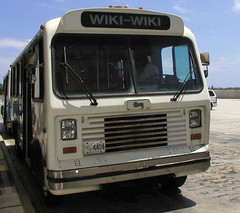
I can't get enough of this. The University of Manitoba recently posted the video of Micheal Wesch's June 17, 2008, talk entitled "A Portal to Media Literacy" where you can get a glimpse into how Micheal organized a couple of his classes at Kansas State University. He strives to create platforms of participation for students that leverage the emerging media environment. He shows how to let students participate in their learning in an open way to harness the 'upload world' they are familiar with. Some great illustrations of practices in wiki and RSS aggregator usage are found in this video... just in time for this week's CCk08 topic of Instructional Design and Connectivism! Food for thought!

In fact, I'm revamping one of my courses for Winter 2009 (Biol2: Intro to Molecular Biology) and I am going to use a wetpaint wiki as a type of portal for my students to bring together course information. I'll be sure to write about it on this blog once I get the wiki slightly more crytalized.

Note: image credit located here.

Thursday, October 16, 2008

CCK08: Facebook for Academics

If you are a faculty member or administrative staff at a college or university then you might be tempted to check out Academia.edu. Probably the simplest way I can describe it is to call it "Facebook for Academics." All institutions are organized on the top level of a 'tree' (i.e. an organizational chart). The second level of the chart shows the departments within the institution and the third level shows the individual faculty and staff. Once you add yourself to the respective tree branch, you can select your research interests, display a photo and post a professional profile which includes aspects such as articles published, books authored, CV, important websites, contacts, courses you are teaching, etc. This social networking site is a great way to connect with other faculty members at other institutions working on similar topics. This has the potential to be a very interesting resource as it grows. As of mid-October 2008, there are over 6300 people registered. (7 more people joined in the time it took me to write this blog post!)

PS: this blog post fits nicely into the Connectivism course topic for week 5: Groups and Networks.

Tuesday, October 07, 2008

CCK08: The most successful network in history!

Last week in CCK08, the longest thread in the discussion forum was on the question: “Which is the most successful network in history”. There were some very nice suggestions such as:
  • The network of international health care professionals linked together after experiencing outbreaks like the SARS.

  • The solar system – which networks planets

  • Evolution – as a self-assembled network that led to higher life forms on Earth

  • The brain – a dynamic, thinking and emotional network

  • The Internet – speed of information flow and repository of data

I think you might agree with me that those are all good examples. At least one important and immensely successful network is missing off this list: the telephone network. In the last 125 years, this network has evolved and adapted to serve the needs of the industrial revolution all the way into the 21st century and while I am no expert on predicting the future, I am predicting this network will continue to grow in its importance for generations to come.

This being said, the telephone network is slowly merging with the data network. So maybe in the future, all communications networks will be merged together with so much overlap and interconnectedness that distinctions will be difficult to identify.

Anyway, is this good for distance learning? YES! The telephone is important for distance learning. Not only is it a simple and reliable way for an instructor to communicate with a student but it also provides students access to a data network on some telephones. For example, I’m writing this blog post from my iPhone. It’s iFun! Access to this data network on a telephone exponentially increases the functions that a student can perform in support of their own learning using a telephone.

Can you suggest a candidate for the most successful network in history? If so, can you explain how this network might support learning in a practical sense?

Note: image attribution here.

Friday, September 19, 2008

CCK08: 69 Learning Adventures in 6 Galaxies

This week in CCK08 the discussions have revolved around aspects of knowledge. Some people have engaged in discussion around definition knowledge, others have tried to explore how knowledge is stored in the brain. Some have extended the discussion to the concept of understanding and there was a very interesting discussion on how knowledge or learning can take place in a ‘non-human appliance’ – be it social software or a robot! The topics that appeared made for quite a philosophical week in the course.

Now I’m not much of a philosopher – I’m a scientist. So I didn’t quite know what to contribute. I do know that knowledge, understanding and learning has been the cornerstone of my life as young adult all the way into adulthood. I’m a very inquisitive person always looking to learn new things. Consequently, I am a good “knowledge seeker” - a good researcher. So in the spirit of information gathering, I thought I would share with the readers of this blog a very nice resource.

69 Learning Adventures in 6 Galaxies.

Sounds like a bit of a gimmick title right? Well, it’s not. It’s a free eBook by Zaid Ali Alsagoff, the e-Learning Manager for The International Centre for Education in Islamic Finance (INCEIF) in Kuala Lumpur, Malaysia. He’s assembled a very easily readable eBook that covers six major topics (aka Galaxies!): Learning, Teaching, Stories, Free e-Learning Tools, Free Learning Content and Free EduGames. In conjunction with his blog called Zaidlearn, it provides a nice set of resources for the practitioner who is in "knowledge seeker" mode.

Enjoy.

Note: image attribution here.

Friday, September 12, 2008

CCK08: Connectivism Concept Map

This week I read a few things circulating in the blogosphere about Connectivism. Most of it is interesting. The readings provoked me to give some thought to the concept of exactly how I am connected to the message pipelines and communication networks around me. I noticed that there are some message pipelines that I exclusively make a conscious effort to take from at a time point which is convenient to me. Such as television. I do not routinely watch television. In fact, I have not been in the presence of a television (turned on) in the last four days. So how does the message pipeline of a television influence me - well, I simply take from it once in awhile. On occasion I make a conscious choice to turn on a TV and watch it. I never give to that message pipeline - I only take from it.

In contrast, I gave some thought to how I use the phone. The phone pushes information to me automatically (i.e. phone calls come to me directly on a routine basis) and I routinely push information to the phone (i.e. I call people through the day). So clearly the way television keeps me connected is different than the way a phone keeps me connected. However, both are part of my 'Personal Connectivism' map.

I tried to visually represent this phenomenon of my 'Personal Connectivism Map' visually. I used CMAP Tools. If you are new to CMAP tools then you might find this post useful.

Take a look at my 'Personal Connectivism Map' and let me know what you think by leaving a comment below. Click the image below to go to Flickr where you will have the ability to choose from a variety of image sizes, if necessary (see the 'All Sizes' button).

Tuesday, September 09, 2008

CCK08-Connectivism is here!

The massively online open course on Connectivism has begun (see description here). Already there is so much material on the subject that some of the participants are very surprised and somewhat overwhelmed. In my view, I think the key is not to get stressed out with the large volume of material that will be channeled to participants in CCK08. Learning is supposed to be fun - so I am adopting the approach of simply 'going with the flow' for the next 13 weeks. I'm going to read a few things that interest me each day (mostly from 'the daily' email produced by the instructors and from the Pageflakes RSS aggregation page). And when I 'feel the urge' I will blog about something related to these materials in my regular blog here - I'll be sure to add the tag CCK08 to the postings. I have no specific goal (or expectation) in mind as to the number of readings I will complete each day nor the number of blog postings on CCK08 I will make each week; however, I will keep an open mind and see what happens. I am here to enjoy the ride with the least amount of stress as possible. I know I will learn
something on this journey - without giving myself a heart attack along the way (*haha*)

I hope the same for everyone else that is a participant in CCK08!

PS: If this posting intrigues you - it's not too late to join into CCK08. Give it a try!